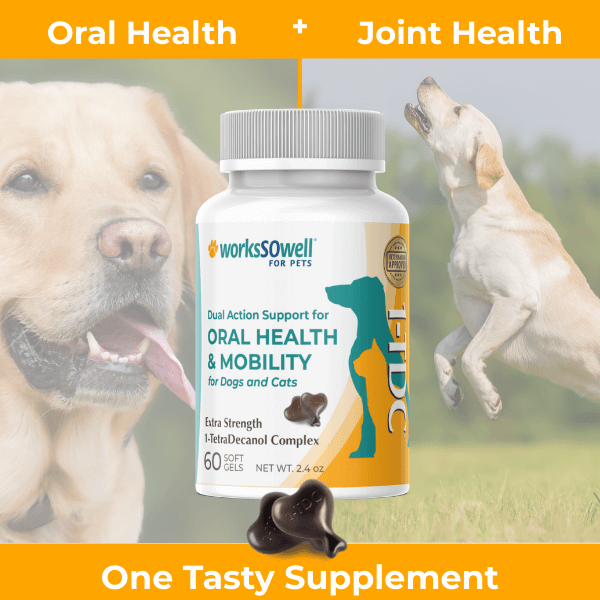
The $500 to $1,500 dog dental cleaning your vet just quoted only resets the problem
It doesn't stop it from coming back the next day.
If you're reading this after a vet appointment that ended with a number that made you sit down, you're not the only one. The cleaning your vet quoted. The anesthesia question you asked. The 'is there anything else I can do first' that came out before you'd even decided to book it. You went in because of something you'd already noticed at home. His breath, the color of his gums, or the way he turned his head when you tried to look.
That's the exact moment this page is for. If your vet has told you going under isn't an option (not something to be nervous about but something that's actually off the table), this page is for you too.
You already know something's wrong. What you probably don't know yet is why the cleaning alone doesn't stop it, and what 500+ vets recommend doing between visits so you're not back here again in eight months.
A cleaning is a reset. Not a routine.
Most owners never hear this at the vet's office: a professional cleaning is a reset, not a maintenance plan. It clears what's already built up, but doesn't stop what starts building up again the next day. And that new buildup starts sooner than most owners would guess.
A new film begins forming on the teeth within about 24 hours of a cleaning. Left alone, that film is what eventually becomes the tartar you were just paying to have removed.
If he's had a cleaning before, you already know how this goes. His breath is better for a while. Then one morning it isn't.
Cleanings are real medicine. If your vet recommended one, that recommendation stands. That visit just isn't built to walk you through what to do in between. If nobody ever covered that with you, that's not something you missed.
You know how this works in your own mouth: a cleaning twice a year, and brushing every day in between. Your dog gets the twice-a-year part.
The missing piece is the in-between, daily prevention that works on the gums between cleanings, not instead of them. Brushing helps with what you can see. It doesn't reach what's happening below the gumline. The daily habit that does is called 1-TDC.
My dog went from needing a dental this year to not needing a dental due to this product. I used it along with an enzymatic toothpaste. I brush her teeth and then apply 1-TDC. Her plaque came off and her inflamed gums have resolved.
Plaque and tartar are what you can see. They're not the actual problem.
Most owners think of dental health as a plaque-and-tartar problem: brush more, get it scraped off at the vet, done. That's not wrong, exactly. It's just not where the real issue is.
Plaque and tartar are what you can see, and they're what most products and most certifications are built to address. The VOHC seal, for example, the one you'll see on dental chews and water additives, certifies products for controlling plaque and tartar specifically. It's not the same thing as certifying a product for gum health. That's a separate question, one VOHC's seal doesn't answer.
The gums are where the real problem takes hold. Periodontal is the clinical word for it, and it just means the gums and the bone holding the tooth in place. Tartar sitting on a tooth is a symptom you can see. What's going on below the gumline decides whether that tooth, and the bone under it, stays healthy long-term. That is the part a board-certified veterinary dentist looks at.
What's below the gumline also decides the size of the next quote. A routine cleaning is what your vet quoted. When the gums have pulled away from the tooth and pockets have formed, the cleaning has to go below the gumline (root planing), and the number moves: a dental can run as high as $3,500. The quote you were given is the version where the gums are still holding.
98.6% of dogs over a year old already have gum damage
A recent veterinary study found that 98.6% of dogs over 1 year old brought in for an exam already have some form of periodontal breakdown or a fractured tooth (Stepaniuk et al., 2026, Journal of Veterinary Dentistry). This isn't a rare problem. It's close to universal, and it's exactly why the gums, not just what you can see on the teeth, are the actual issue.
Dr. James Anthony
Chief Medical Officer, worksSOwell
BSc(Agr), DVM, MRCVS, FAVD, DAVDC, DEVDC, Pag
Vancouver, BC
"I was amazed at the positive results"
"Based on a study I performed at the University of Saskatchewan, I was amazed at the positive results from the use of the 1-TDC technology (unique fatty acid oils). All periodontal measurements in the test animals improved significantly. The more I use the 1-TDC technology, the more impressed."
Dr. Judy Morgan
DVM, CVA, CVCP, CVFT
Zebulon, NC
"1-TDC is an amazing product"
“I’ve used 1-TDC for my animals with gingivitis and stomatitis and dental issues. This really helps decrease that discomfort and irritation associated with dental issues. 1-TDC is an amazing product that you can apply directly along the gum line. You can also apply it on sore joints because this will help decrease discomforts associated with joint issues. So you are getting two for one deal.”
Barden Greenfield
DVM, Diplomate AVDC
Nashville, TN
"1-TDC for all perio cases"
"1-TDC has been a tremendous addition to our post-oral care armamentarium. Fatty acids have been documented to have anti-inflammatory properties, and I have seen clinical improvement in dogs and cats using 1-TDC (with existing periodontal issues). I prescribe 1-TDC for all periodontally-related cases, and since the palatability is so high, compliance is fantastic."
That's on top of 500+ vets who recommend 1-TDC, and over 10 years on the market. Not a new supplement making a new promise. Dr. Anthony, 40 years a board-certified veterinary dentist, put his name on it.
Why daily prevention works when a cleaning alone doesn't
Plaque isn't really the problem. Bacteria make up about 98% of it, and left alone, that bacteria inflames the gums. Inflamed gums make it easier for more plaque to build up and harden into tartar, which inflames the gums further. It's a spiral, not a one-time event, which is why a single cleaning resets the clock instead of stopping it.
That bacteria is also what you're smelling. The breath isn't a separate problem from the gums. It's the same problem, reaching your nose.
1-TDC is built around a specific type of fatty acid, and the form matters. Those fatty acids are esterified, which is a deliberate part of how the formula works, not an incidental one.
That structure is also part of why 1-TDC is designed to absorb quickly through the tissue in the mouth, rather than needing to be broken down through digestion first.
According to Dr. James Anthony, worksSOwell's Chief Medical Officer, 1-TDC binds to T-helper cells (a type of immune cell), which carry it to sites of active inflammation throughout the body, gums and joints included.
Once there, the fatty acids 1-TDC delivers convert into compounds the body uses to calm inflammation and stabilize the affected tissue. That's the same process working below the gumline daily, not just during a cleaning.
In a clinical study of cats with chronic periodontal problems, 1-TDC reduced gum pocket depth, gum attachment loss, gum inflammation, and bleeding, compared to placebo, over six weeks (Kubitza & Anthony, 2019, Journal of Feline Medicine and Surgery).
That study was done in cats, and your dog is not a cat. According to Dr. Anthony, research on products like this runs in dogs, cats, and mice, and cats and dogs are both mammals with closely similar biology and inflammatory systems. He adds that he has seen 1-TDC do the same thing in dogs in his own practice, which he counts as clinical experience rather than study data.
The immune cells that carry 1-TDC to his gums travel everywhere else in him too. Inflammation starting in the mouth doesn't stay in the mouth either. When researchers examined 44 dogs, they found that the more periodontal breakdown a dog carried, the more likely they were to also find changes in the heart valves, the liver and the kidneys (Pavlica et al., 2008, Journal of Veterinary Dentistry).
The joints belong on that list too. In a mouse study, gum inflammation on its own showed up as bone loss inside a joint, and the mice that had arthritis too developed it faster and more severely (Cantley et al., 2011, Journal of Clinical Periodontology).
That is why a board-certified veterinary dentist thinks about gum health as whole-body health and not as dental work. And it is why the same softgel that works below his gumline also reaches his joints.
If the joint half sounds like it isn't about your dog, it might be. Researchers x-rayed 30 dogs aged four to ten while they were in for a dental cleaning, none of them carrying a joint diagnosis. 18 of the 30 had joint changes showing on the films, on an average of three joints each, and most of their owners had no idea (Millis & Hecht, 2026, JAVMA). The changes were already there. The signs hadn't arrived yet.
That's the case for doing something daily. 1-TDC doesn't replace a cleaning. Cleanings and chews remove what's already built up. 1-TDC works on the inflammation that makes buildup accelerate in the first place. Used together, that's a complete routine: mechanical removal, plus a reason removal doesn't get undone as fast. And nothing else on the shelf works on his gums and his joints together.
Stepaniuk KS, Gingerich W, Ziche AM (2026).Journal of Veterinary Dentistry. Oral examination of a random anesthetized canine population. 98.6% of dogs over one year old showed some form of periodontal breakdown or a fractured tooth.
Kubitza F, Anthony JMG (2019).Journal of Feline Medicine and Surgery. Six-week placebo-controlled study in cats with chronic periodontal problems. 1-TDC reduced gum pocket depth, attachment loss, inflammation and bleeding.
Pavlica Z, Petelin M, Juntes P, et al. (2008).Journal of Veterinary Dentistry. 44 dogs examined. Greater periodontal burden was associated with a higher likelihood of changes in the heart valves, liver and kidneys. An association, not a demonstrated cause.
Cantley MD, Haynes DR, Marino V, Bartold PM (2011).Journal of Clinical Periodontology. Mice given gum inflammation alone showed bone loss inside a wrist joint. Mice given gum inflammation before arthritis developed the arthritis faster and more severely than mice with arthritis alone.
Millis DL, Hecht S (2026).JAVMA. 30 medium-to-large dogs aged four to ten, none previously diagnosed with joint problems, x-rayed during a routine dental cleaning. 18 had joint changes on the films, averaging three joints each. Most of their owners had not realized.
Here's what daily improvement looks like week to week:
Internal gum changes begin and inflammation starts to decrease within the first 1-2 weeks, even though you won't see it yet.
Between 4 and 8 weeks it moves to things you can actually notice. Breath is usually the first, because you don't have to look in his mouth to catch it. Gum color and day-to-day comfort follow.
After that, it's ongoing support for as long as you keep him on it.
44,000+
pets are already on this routine
85%
of surveyed customers saw visibly improved oral health
93%
of those customers saw results within 1-2 months
101
verified 1-TDC customers surveyed
Six ways to give it, built around what your dog already does
1-TDC gives you real flexibility here, which matters because "how do I actually give this to my dog" is the single most common question owners ask before they buy.
If his mouth is still sore, or he's never been thrilled about anyone reaching for his gums, you don't have to fight him for it: two of the four oral options below, the food topper and the whole treat, never touch his mouth directly. The other two get you the fastest gum benefit, for dogs who tolerate it.
Orally, four ways:
Squeezed directly onto the gums
Licked straight off your finger
Mixed in as a food topper
Given whole as a treat (still supports mobility fully. Gum benefit builds more slowly this way, since the gel isn't touching the gums directly)
Topically, two ways:
A concentrated dose applied directly to a joint area, for dogs who need extra mobility support (say, a stiff hip or a limping ankle)
Applied to the inner pinna (the ear) and wiped off after 10 minutes. As a precaution, this is the route we recommend for dogs with IBD (Inflammatory Bowel Disease), pancreatitis, or similar digestive sensitivities, since a joint or paw application can still be licked off. It also works for any dog you'd rather not give it to by mouth.
Most owners land on one of the first four and never think about it again. It fits into whatever your dog already does at mealtime or treat time. No separate ritual, no fighting to get a pill down.
Dosing is simple and based on weight:
Pet weight
Daily dosage
Under 25 lbs (small breeds)
1 softgel every 2 days
25-50 lbs (medium breeds)
1 softgel daily
51-100 lbs (large breeds)
2 softgels per day
100+ lbs (extra large breeds)
3 softgels per day
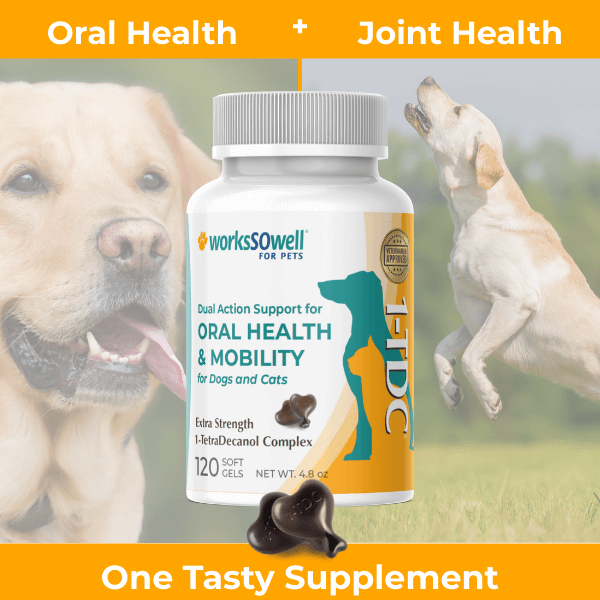
A 120-count bottle runs about eight months for a dog under 25 lbs, and about four months at 25 to 50 lbs.
What daily prevention has looked like for owners already doing it
Puppy, senior, working dog, competition dog: whatever stage your dog is at. Here's the difference it's made for owners already doing it.
★★★★★
"Within a week his gums were less red and a healthy pink."
"After having a number of teeth extracted two years in a row due to gum disease, my vet advised me to try 1-TDC on my nine year old furbaby. Within a week of using this product his gums were less red and a healthy pink instead. It's now been over three months of using this product daily, and his gums remain a healthy pink, and most noticeable is that his "death breath" hasn't returned, at all. We're absolutely delighted, and hopeful that his next checkup in May won't include the need for more extractions. If only I knew of this product when he was a baby, we could have prevented all his dental issues."
★★★★★
"It took less than 2-3 months for the plaque to start coming off in chunks."
"I started using this on my 14 year old dog's teeth and the photo really says it all. It's been a few years now so my memory isn't 100%, but it took less than 2-3 months for the plaque to start coming off in chunks. Awesome product and much cheaper than a dental!"
★★★★★
"Her teeth are spotless. Her gums are all evenly pink."
"Our puppy has been on 1-TDC since she was 4 mos old. She is now 14 mos old and ALL her teeth are spotless, and her gums are all evenly pink without any redness. Our vet isn't quite convinced it's the 1-TDC, but, l'll convince him, eventually. She truly looks forward to our routine game after finishing dinner... she must "Wipe" her doodle beard, to get her "TEEF" coated, and then the ultimate daily treat of the empty capsule."
★★★★★
"Very pleased with the results."
“Our vet recommended the Works So Well oral health support for our dog’s inflamed gums. We’re very pleased with the results. She’s been on it for about 6 months, but we noticed improvement after a month.”
★★★★★
"Her teeth look good & no sedated cleaning is needed."
"Willow is a very active, 9 year old Treeing Walker Coonhound! She loves my friend’s dock diving pool in the summer. It should also be noted at a recent Vet appointment: after being examined by the vet- her teeth look good & no sedated cleaning is necessary. I’m very pleased with WorkSoWell 1-TDC!"
★★★★★
"I'm very impressed with 1-TDC!"
"Top pictures are before and bottom are after 5 weeks. I can definitely see an improvement in her gums and teeth! I'm very impressed with 1-TDC!"
If you've already tried a dental chew or a water additive that didn't do much, you're not wrong to be skeptical. Most of what's out there works on the surface. This one is built to work below it. That is the difference between a product that cleans what you can see and one that reaches what you can't.
Your dog's next cleaning quote doesn't have to look like the one your vet gave you
This isn't instead of what your vet recommended. It's what happens in between: the daily habit that works on the same problem a cleaning resets, so you're not paying to reset it again in eight months. You already know the cleaning your vet quoted isn't the end of this. The question is what you do with the time between now and the next one.
60-day money-back guarantee. 500+ vets already recommend it.
How subscriptions work:
15% off for life
FREE U.S. shipping on every delivery
FREE products on 3rd, 6th & 9th shipment
Pause or cancel anytime (with a click of a button)
Fair question, and the honest answer has two halves. Most products sold for dental health work on what has already built up, the plaque and tartar you can see. 1-TDC supports your dog's own healthy inflammatory response below the gumline, which is a different job.
The other half is what it isn't. This is daily support, not a procedure. In a survey of 101 verified 1-TDC customers, 85% saw visibly improved oral health, and 93% of those saw results within 1-2 months.
Most owners see visible change between 4 and 8 weeks. Three named veterinary specialists have put their names to it publicly, two of them board-certified in veterinary dentistry. And if it does nothing for your dog, you have 60 days to say so and get your money back.
Yes, and the reasoning runs differently for you than for anyone else reading this page. Everywhere above, daily support fills the gap between cleanings. In your case there is no gap to fill. It becomes the entire routine.
So be clear on what it does and doesn't do. It will not remove what has already hardened onto the tooth. That is mechanical work, and only a cleaning does it.
What it does is support the gum tissue below the gumline, every day, which is where periodontal problems take hold in the first place.
Your vet knows his full history and made that call for a reason. Bring this up at the next visit and ask how daily gum support fits the plan they already have for him.
No. What is gone is gone: extracted teeth don't come back, and tartar that has already hardened still needs a cleaning to come off.
What is still in play is every tooth she has left and the gum tissue holding them in, and that tissue takes the same daily support whether you started five years ago or this week. Chantal, quoted above, started after her dog had teeth pulled two years running.
One active ingredient: 1-TDC, a 420mg proprietary blend per softgel, sourced from beef. The rest of the softgel is carob, wild Alaskan salmon oil, gelatin, glycerin, purified water, and non-GMO soybean oil. Third-party tested. GMP certified. Made in the USA. No artificial preservatives, flavors, or colors. No fillers, no binders, no GMOs.
If your dog has a beef allergy: allergies come from protein, and 1-TDC® is a fatty acid. So, any animals allergic to beef should be safe. Of course we recommend you consult with your veterinarian first who has a full medical history of your dog.
1-TDC has no known drug interactions. Even so, check with your vet before you add it, since they hold his complete history and yours is the dog they actually know.
Timing puts no constraint on you from our side: before a meal, after a meal, with a meal, morning or evening, and no waiting before he eats or drinks.
One-time orders ship for $6.99, free over $99. Subscriptions ship free on every delivery. We ship to Canada at a flat $15.
I cut the top off of the outside and squeeze it along my dog's gums and he's in heaven and then he choose the casing like a treat. His breath is never smelled so wonderful!! Every other day I squeeze it onto his toothbrush and brush his teeth with it.
My dogs love this product. However, it does not travel well in the summer to South Texas. I have now received 2 orders where the ingredients had separated out, making it almost impossible to use. If they could do something about that, it would be the greatest product.
My dogs (all 8) of sizes ranging from small to large look forward to getting their TDC supplements! They absolutely love the taste of it and practically wait in a line to get the supplement put on their gums and to eat the capsules after.
As an owner this is a huge deal as most of the time dogs are not enthusiastic about taking a supplement that is actually good for them, let alone one that targets multiple different things!!
We will be longtime users and look forward to converting more people to help out their dogs in such an easy way.
This stuff is a miracle. My dog's teeth were going bad and her breath smelled. The vet was talking about dental services in the near future. $$$$!! After trying powders, chews, sticks, toothbrushes, food additives, and water additives, which may have worked if either she or I could put up with them, we found these. Since she also has a bad hind leg joint, I thought -- solve two problems at once, what could be better. It's been about a month, and her breath is perfect. Her teeth look markedly improved. Most importantly, she actually asks me to spread it on her teeth, and her tail wags the whole time. At first, she would pull her head away and she wasn't happy with my finger in her mouth, but now she actually asks me to do it. My other dog, whose teeth aren't as bad, got jealous, and now I have to treat both of them. They really like the taste. They have fresher breath than I do, and the teeth are improving daily.
Store owner replied:
That is awesome and we are soo happy that your dogs love their 1-TDC! We would love to see a picture of your dogs or a video would be amazing!
I purchased 1-TDC for my Border Collie, who will be 10 next month, and our Mini Aussie, who injured her back right leg and has been limping around on 3 legs for a couple of months. At the advice of her vet, we have been taking her out to go pee on her leash, and have put ramps in so she doesn't have to do the stairs. She was showing a little improvement, but now that she has been on 1-TDC for about 3 weeks now, she is walking much better, and only limps when she's TRYING to run. I haven't noticed any difference in our Border yet, but she didn't have any issues, and it's just to help keep her in good shape as she participates in flyball. I definitely believe this helped our Mini Aussie though, and will be purchasing more.
Store owner replied:
Thank you so much for sharing both of your experiences. We are so happy to hear that your mini Aussie is feeling better and has improved mobility. Please add a picture of your dogs, we would love to see them!
The first dog I bought this for was a 6yo rescue with awful teeth/mouth. She started this before her dental and has continued since. Her mouth is much healthier and she's still moving well at almost 11yo.
I adopted another dog at 8yo. She's been on 1-TDC since I got her 6 months ago.
This is a great two for one product that addresses 2 common issues, joints and mouth.
We walk every day.
Store owner replied:
Thank you for sharing your experience with both of your dogs. We are so happy to hear that they have both had improvements with their oral and joint health. Please share a picture of them with us, we would love to see them.
Store owner replied:
Thank you for sharing the feedback from your vet. We love to hear that. Keep up the great work and please feel free to add a picture of her.
We love giving our fur-baby the 1-TDC every day, as his "vitamin".
He used to have horrendous breath - and we were at a loss at what "else" we could try, as we had tried so many methods that didn't work.
After a week of giving him 1-TDC, his breath was noticably sweeter, and it still continues. Bailey has been taking 1-TDC for some time now, and his breath is as fresh as a puppy's.
I should mention that Bailey's now 10.5 years old, and he still runs around the yard, playing with his friends, like he did years ago. He loves his toys, and often tries to engage us in his playtime. And he's still able to jump onto our high bed. I credit 1-TDC for his continued mobility in his senior years.
Store owner replied:
Thank you for sharing your experience, we are so happy to hear that he is feeling like a puppy at 10.5 and has puppy breathe! We would love for you to add a picture of Bailey!
So easy to use dogs love it. Helps keep them active and happy.
Store owner replied:
Thank you for sharing the improvements that you have seen. We would love to see a picture of your dog.
I have been using this for my 10 yr old Lab/German Shepherd mix for about a year and this has helped her joint issues tremendously. We will continue using going forward. Thank you !
Store owner replied:
Thank you for being a loyal customer and sharing your feedback. We are so glad that 1-TDC has helped her joints. Please add a picture of your dog, we would love to see her.
My Aussie has been on 1-TDC since he was a puppy. He's now 8. His teeth look amazing and he receives compliments at his annual Vet visits. Our new puppy has already begun taking 1-TDC. Why not - we know it works!
Store owner replied:
Yeah, that is fantastic! Thank you for sharing! We would love to see a picture of our long time loyal pup and the new puppy as well!
My dog loves these. I shake the bottle and she comes running. I have been using them for a month and I can her gums looking healthier. I really appreciate that she enjoys the taste. I cut off the tip and easily squeeze it in her gums then give her the rest to chomp on.
Store owner replied:
Thank you for sharing, they do love it (beef flavored) as a tasty treat. If you will, please share a picture of your dog and even her healthy gums.
It's been a month now and I'm already seeing a difference in her physical activity. I will continue to use.
At this time I did order thru Chewy as it was cheaper.
Store owner replied:
Thank you for sharing your results, we are so happy that your dog is feeling great! Keep an eye on our website or in your email for sales on 1-TDC. Please share a picture of your dog, we love to see pictures of our pet customers.
My son's dog is running like a dog half his age. He'll be 11 soon and you'd never know it! Thank you 1TDC!
Store owner replied:
That is awesome!! Thank you for sharing. We would love to see a video or picture of him running and playing like a youngster.
I’ve used the supplement for my dog for almost a decade. She’s now 14 and most people think she’s much much younger than her age. She retired from agility at 11 and parkour at 13. Never had any injuries or joint issues. I credit 1-TDC Oral Health for contributing to my girl’s longevity and joint health.
Sadly it’s gotten harder and harder to source the product.
Store owner replied:
Thank you for being a very long time, loyal customer. We are so happy to hear that 1-TDC helped her continue to do the activities she loved for so long! Please share a picture of your dog, we'd love to see a long time pet that loves 1-TDC.
Using this primarily for my pups teeth. Really improves the gum health.
Store owner replied:
Thank you for your review, we appreciate you sharing your experience. We would love to see a picture of your dog if you would like to share.
I have used this product for years. I have not noticed their teeth getting better but they definitely haven't gotten worse. Pete is 16 and his mobility has improved especially during the winter months. He is a little stiff when he first gets up in the morning but like me, he walks it off within a few steps. I highly recommend this product and have to many others.
Store owner replied:
Thank you for sharing, you are doing the right thing by using 1-TDC as a preventative to keep his mouth healthy. We love that it is helping Pete's mobility - 16 wow, that is awesome. We would love to see a picture of them.
I think its working! Been using it for about a month and a half for our dogs breath and that combined with Plaque off seems to be working!!
Store owner replied:
So glad that 1-TDC has given you such great results, thank you for sharing. Don't forget to share a picture of your dog, we love to see them.
It's only been 20 days but I am definitely seeing an improvement in the condition of her teeth and gums.
Store owner replied:
Thank you for sharing. Taking pictures are an amazing way to see the results.
Great orange and mobility support. My kitty who had bad, painful mucositis responded well where she didn't need any pain medications. My dog who had patellar injury maintained mobility until his surgery and continues with the supplement. Definitely a great supplement for our family pets.
Store owner replied:
We love that your dogs are feeling the difference and you are seeing it. Please add a picture of your dogs, we would love to see them.
This stuff works! My dog had terrible breath. After two weeks of daily use his breath is now fresh! Just like they said it would. Buy it! Best money spent.
Store owner replied:
Thank you for sharing and thank you for the awesome picture!
Our vet recommended the Works So Well oral health support for our dog's inflamed gums. We're very pleased with the results. She's been on it for about 6 months, but we noticed improvement after a month.
Store owner replied:
Mary, thank you for your review. if you find that she does better on 2, you can keep her on that dose. Please contact us with any questions. Also, we would love to see a picture of your girl.
I was getting ready to put my 14 1/2 year-old dog on some type of prescription pain meds as she appeared to be in pain and stiff all the time.. However, the works so well tdc1 saved her from that. Her mobility is good and she limps so much less. She doesn’t appear to be in pain anymore. Also no side effects noted. She is happy and sassy as ever. A+ recommended.
Store owner replied:
Thank you so much for sharing and we are glad that she is feeling better - more mobile. Thanks you for the picture, she is very cute.
I bought these after a vet recommended them to help with my pug's teeth and overall oral health, and the joint health was a bonus (she just got double TPLO). In general, I feel it's hard to say a supplement is really working for its intended purposes, especially for a dog. However, we did have a vet visit the other day, and she said the teeth/mouth were looking good. Our next dental is not for a few months yet. We have also added other measures, too - brushing more, etc. My dog really likes the supplement, and it doesn't seem to be hurting her, so I plan to continue giving it to her. It seems like a good product and vet-recommended. The outside of the supplement is too hard for her to chew, so we throw that part away. This could be because she doesn't have many teeth left to chew it; it's kind of rubbery, and I feel it's a choking hazard for her. Pug-approved!
Store owner replied:
Thank you for sharing your experience. Great news that your vet sees her oral health results. It is ok that she does not eat the capsule itself, it is edible, but not necessary to give it to your pet. Please add a picture of her, we would love to see her.
Have used this product for years and find it so beneficial for my dog
Store owner replied:
Thank you for being a loyal customer and we love to hear how well 1-TDC is working for your dog. Please add a picture, we would love to see him/her.
Our dog Sam is responding well to the TDC1. His joints seem to be more flexible and he is getting more active. We have only been using this about a month, so I am sure we should more improvement.
Store owner replied:
Yeah, great news! Thank you for sharing. We are glad that he is feeling great. Please add a picture of him so that we can say happy, active Sam!
Luna has been taking 1TDC since she was a puppy. I believe that it has helped her to be able to continue to take long walks, run, play games and jump with joy and no pain or injuries! Not to mention her beautiful pearly white teeth!! We love it!
Store owner replied:
Thank you for sharing and being a loyal 1-TDC customer. Luna is beautiful and very photogenic. Thanks for sharing her pretty face with us!
I do not know if it works or not. I hope it makes my elderly doggie feel a bit better. they keep sending me emails to review the product. this is all I can say. I will keep giving it to her in case it helps. she won't eat it in the pill casing so I squeeze it on her food and mix it up. She does not like the taste.
Store owner replied:
Thank you for sharing. She does not have to eat the capsule, the contents are what is important. Please continue to keep us posted and contact us with any questions - contactus@workssowell.com
60-day money-back guarantee
×
Subscribe and save 15 %
Frequency
Some text in the Modal..
Choosing a selection results in a full page refresh.








 Have multiple dogs? Click here and save with bundles!